
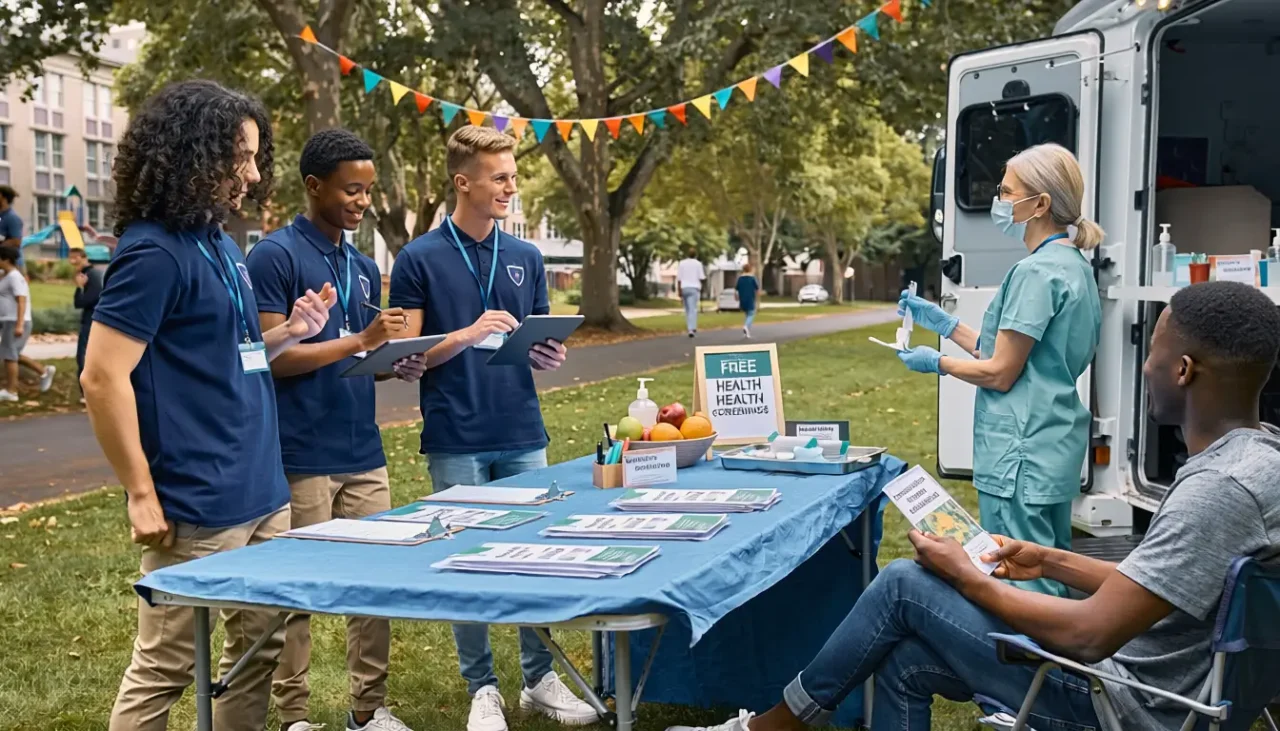

Public health degrees that emphasize community impact combine social sciences, epidemiology, program design, and hands-on practicum to prepare graduates for roles that shape local health outcomes. Programs vary by concentration, format, and field experience, affecting readiness for positions such as health educator, program manager, or emergency-preparedness specialist. Understanding which pathways, skills, and program features matter most can clarify the steps from degree to meaningful community work.
Which Community Roles Can an MPH Lead To?
An MPH prepares graduates to fill diverse community-focused roles that combine program design, education, outreach, and crisis response.
Graduates often become Public Health Program Managers who design, coordinate, and implement evidence-based initiatives, manage grants and budgets, lead teams, evaluate outcomes, and form partnerships across health systems.
Others work as Public Health Educators creating materials, running workshops, and assessing health-promotion effectiveness on topics like nutrition and disease prevention.
Community Health Workers serve as liaisons, guiding individuals through healthcare systems, addressing social determinants, and conducting direct outreach to improve local outcomes.
Social and Community Service Managers oversee service programs, facilities, budgets, and volunteer training, while Emergency Preparedness Specialists develop response plans, coordinate crisis communications, support outbreak operations, and evaluate readiness for future incidents.
MPH graduates also build skills to interpret data and guide system improvements, preparing them to influence program and policy decisions at higher levels of responsibility career growth. A Master of Public Health often includes core courses like epidemiology that ground students in methods used across these roles.
MPH Concentrations That Drive Community Impact
Drawing from specialized tracks that blend theory, practice, and community engagement, MPH concentrations translate public health principles into targeted action for diverse populations.
Behavioral, social, and community health trains students to analyze social determinants, design and evaluate interventions, and manage funding for programs, with options for dual concentrations or certificates. Students also complete a required set of concentrated courses totaling 12 credits to build expertise in theory, intervention design, and program evaluation.
Community health practice and methods emphasizes applied science, research writing, and preparation for administrative roles, offered full- or part-time and through flexible delivery, including pathways for experienced professionals. The program is housed at one of five historically Black colleges and universities in the Atlanta University Center Consortium, reflecting a commitment to serving underserved communities MSM.
Community health education centers on assessment, health promotion, program design, and evaluation for work in health departments, nonprofits, and global organizations.
Health equity and underserved population tracks combine research, epidemiology, policy, and required service-learning to reduce disparities.
Global and urban community health addresses social, economic, and environmental drivers in resource-limited settings.
Community-Focused Bachelor’s Degrees and Entry Points
Across community settings, bachelor’s degrees in public health provide clear entry points for careers in health promotion, disease prevention, and program implementation.
Undergraduate conferrals grew from 1,448 in 2003 to 12,895 in 2016, concentrated in research universities and regions like the Southeast and West.
Common majors include public health education/promotion, community health, and general public health; CEPH-accredited programs supplied over half of 2016 degrees.
Community colleges play a limited role in public health compared with other health fields, though they dominate allied and practical nursing pipelines. Accreditation expanded eligibility to include stand-alone undergraduate programs in 2013, supporting program growth and consistency.
Community colleges also offer a substantial share of healthcare programs overall, accounting for 51% of such programs at U.S. higher education institutions.
Community-focused BS and BSPH programs combine social and behavioral sciences, epidemiology, administration, and biostatistics, with online and accelerated formats.
Curricula build practical skills for immediate entry or further study, supporting community empowerment and public health workforce expansion.
Health Educator & Community Health Worker Careers and Salaries
Health educators and community health workers occupy a range of roles that reflect varied responsibilities, settings, and pay scales, with a national average salary near $50,531 (March 2026) but median and percentile figures indicating substantial dispersion.
Typical wages span roughly $19.71 to $27.40 hourly (25th–75th percentiles), while the Bureau of Labor Statistics reported a $63,000 median (May 2024).
Entry-level averages sit near $56,293, though true starting pay averages $41,236 with early-career earnings around $53,418; top entry-level earners reach about $80,500.
Geographic and specialty differences are pronounced: higher pay in Alaska and California and roles from community nutrition ($44,715) to ambulatory service representation (over $105,000).
Employment growth mirrors the average at 4%, with roughly 3,200 openings expected. The typical work environment includes hospitals, wellness centers, and public health departments, and many positions require at least a bachelor’s degree in a related field, making average base salary a useful benchmark.
MPH in Health Behavior & Promotion: Careers in Outreach
Connecting communities to usable health information and services, an MPH in Health Behavior & Promotion prepares graduates for outreach-focused roles that blend program design, education, and partnership building.
Graduates often serve as Community Outreach Coordinators, forging partnerships, organizing events, and running targeted social media and email campaigns for public health promotion.
As Program Managers they design and oversee initiatives, align projects with organizational goals, manage budgets and resources, and supervise staff and training for nonprofit and local health department efforts.
Public Health Educators assess community needs, create instructional initiatives, deliver presentations to schools and agencies, and train colleagues.
Patient Education Specialists tailor behavior-change interventions, maintain follow-up contact, and collaborate with clinical departments.
Health Promotion Coordinators produce prevention materials, manage relations at medical centers, and work with officials on wellness challenges. These roles also emphasize developing core competencies like communication, policy planning, and data assessment. Representatives often take on leadership positions in local health departments.
Biostatistics & Epidemiology: Data Roles Shaping Programs
Where outreach professionals translate research into community action, biostatistics and epidemiology supply the data that shapes those programs.
Biostatisticians develop mathematical methods, design studies, and analyze observations, surveys, and biological samples to identify disease causes and evaluate interventions. They decide what data are needed to answer specific public health questions. Epidemiologists conduct field and analytic studies to map disease patterns, risk factors, and distribution across populations, specializing in infectious, occupational, or maternal and child health when appropriate.
Both fields present findings to practitioners, policymakers, and the public, informing program planning, policy, drug development, and global health decisions.
Career paths include biostatistician, data scientist, survey statistician, epidemiologist, surveillance specialist, and public health analyst across government, academia, industry, hospitals, and nonprofits.
Projected job growth and technological advances sustain demand for these data-driven roles.
Environmental Health & Emergency Management: Protecting Communities
In times of crisis and in routine monitoring alike, environmental health and emergency management professionals assess risks, coordinate responses, and build systems that protect populations from natural, technological, and public-health hazards.
They develop emergency procedures, remediate response vulnerabilities, and plan for disasters while coordinating with local officials and emergency personnel.
Careers span local and state government, hospitals, relief services, and academia, with mean wages often between roughly $77,000 and $107,000 and median director pay near $86,130.
Specialized roles—disaster recovery director, health and safety manager, emergency services director—command higher salaries.
Employment has risen markedly over decades, with substantial increases in emergency and relief services and recurring FEMA-declared disasters driving demand.
Job openings average about 1,000 annually, largely for replacements as the field grows steadily.
Employer Skills for Community Health and How Programs Teach Them
Building on the skills used in environmental health and emergency management, employers seek community health workers who combine strong communication and interpersonal abilities with practical service coordination, advocacy, and assessment expertise. Programs translate these employer needs into curricula emphasizing communication, conflict resolution, rapport-building, and culturally appropriate engagement.
Initial intensive trainings establish foundational knowledge and behavioral skills; technical modules teach computer workflows, case management, and service navigation. Ongoing continuing education reinforces assessment, outreach, and facilitation techniques, while disease-specific and healthcare system courses provide context for targeted interventions.
Instruction in advocacy, capacity-building, and root-cause analysis prepares workers to empower clients and address systemic barriers. Practical workplace guidance supports integration into teams, ensuring graduates meet employer expectations for community-centered, evidence-informed practice.
How to Evaluate MPH Programs: Accreditation, Practicum, Outcomes
Evaluation of MPH programs rests on three concrete pillars—accreditation, practicum quality, and measurable outcomes—that together indicate whether a program prepares graduates for effective public health practice.
CEPH accreditation verifies curriculum length (generally ≥42 semester credits), qualified faculty, resources, diversity, community engagement, and workforce development through self-studies, site visits, board review, and periodic reaccreditation cycles.
Accredited programs must integrate field training to develop prevention-oriented skills and community-engaged practice, typically via practicums and culminating experiences.
Outcomes assessment documents competency attainment, certification eligibility (e.g., CPH), alumni placement, and program strengths or gaps in governance and interdisciplinary collaboration.
Prospective students should examine accreditation status, practicum structures, and transparent outcome metrics to gauge readiness for public health roles and eligibility for certifications and employment pathways.
From Degree to Job: Networking, Certifications, and First Steps
With a public health degree in hand, recent graduates should prioritize strategic networking, targeted certifications, and deliberate early-career steps to convert academic credentials into paid roles.
Networking often fills up to 80% of jobs, so graduates should audit school, work, and online contacts, join LinkedIn groups and Public Health Career Club, and attend conferences, job fairs, lectures, and webinars. Set goals—five meaningful conversations per event—dress business casual, bring cards, listen, and follow up within a week.
Pursue certifications via professional organizations, internships, volunteer work, and adviser or alumni guidance.
Conduct informational interviews with specific questions, offer value early, and cultivate mentors who can provide referrals.
Early persistence, timely follow-up, and reciprocal relationships accelerate transitions from degree to employment.
In Conclusion
Public health degrees equip graduates with interdisciplinary knowledge and practical skills to drive measurable community change. Whether through MPH concentrations, bachelor’s pathways, or certification-focused training, these programs prepare professionals for roles in health education, outreach, environmental protection, and emergency preparedness. Accreditation, practicum experiences, and demonstrated outcomes signal program quality, while networking and targeted credentials ease career entry. Ultimately, graduates translate training into community-centered interventions that advance prevention, equity, and population well-being.
References
- https://global.nmsu.edu/blog/healthcare/top-public-health-careers-with-an-mph/
- https://aspph.org/early-career-workforce-trends-what-public-health-wins-2024-and-aspph-graduate-data-tell-us/
- https://online.ewu.edu/degrees/healthcare/masters-public-health/general-concentration/community-vs-difference-explained/
- https://www.online.uc.edu/blog/impactful-careers-in-public-health.html
- https://www.smumn.edu/blog/master-of-public-health-jobs-high-demand/
- https://sph.umich.edu/pursuit/2021posts/career-prospects-for-public-health-graduates-remain-strong.html
- https://online.ou.edu/hub/exploring-careers-in-public-health/
- https://www.publichealthdegrees.org/careers/
- https://careercenter.emmanuel.edu/blog/2025/10/23/public-health-needs-people-with-diverse-skills-and-backgrounds-here-are-9-careers-to-consider/
- https://hspop.uw.edu/mph-community-health/